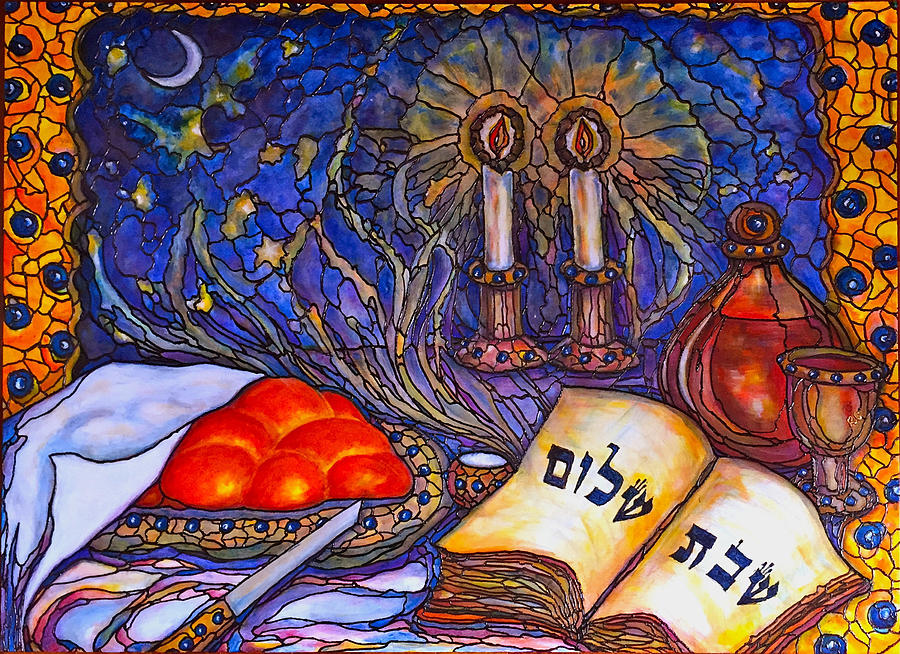
Shabbat Shalom Weekly
Torah Portion: Vayechi
Mission Possible
by Rabbi Jared Viders
Ever get the feeling that you’re in just a tad over your head? Several summers ago on a sweltering July afternoon, our family and countless pieces of luggage were packed into an airport shuttle en route to JFK where we were slated to fly to Israel in celebration of my 40th birthday. Lo and behold, as our driver careened around the entry ramp to the George Washington Bridge, the van came to a sudden halt. The van was dead.
While the driver radioed in for help, explaining that “we need a jump,” pandemonium was slowly unfolding. The stalled van was stationed in a location begging for a collision. The now, non-air conditioned car was quickly becoming unbearable for the younger ones. The older ones, well, they looked somewhat panic-stricken wondering if we really “needed to jump.” [They weren’t familiar with the notion of “jumping” a car and interpreted the driver’s jargon as a call for us to “jump” off the bridge.] My wife gave me that look that says, “You’ve got a plan, right?” While I tried to exude confidence, I was internally in Mayday Mode secretly hoping “my Mommy would somehow make this all better!”
Without any other alternative in sight, we offered a prayer to God and I made my way from the ramp towards toll booth security. And that’s when a 15-person, air conditioned, airport shuttle pulled over in front of our motley crew and asked, “Are you okay? Could you use a lift?” Sent via the Divine Dispatcher, Levi the Shuttle Driver just happened to be returning from the Catskills en route to Queens and was oh-so-happy to offer us a lift to JFK.
In a total state of disbelief, we alighted all the kids and our 52 pieces of luggage and were on our way. We arrived safely at our gate in plenty of time for boarding.
God possesses an endless number of exit strategies out of an endless number of predicaments. Had I explained to my wife, “Let’s just be calm. Hang out for a bit. Probably someone with an empty van en route to Queens will stop off and offer us a ride to the airport. Can you pass me some popcorn?” I probably would have failed miserably in the pro-active, resourceful husband department. That solution was simply out of the question and way beyond the boundary of reasonable possibility.
* * *
“Yaakov said to Yosef, ‘I did not imagine seeing your face, and here God has shown me even your offspring!'” [48:11] [Rashi: It did not enter my mind (lit., my heart did not fill me) to consider the thought that I would see your face again.]
As we navigate the scenarios life sends our way, we envision an array of outcomes. Some end-results are predictable. Others anticipated. Some are remote and others downright incredible.
As Jews, the privilege of 24-7 access to the Infinite essentially renders the “impossible” obsolete. Indeed, it should seemingly be erased from our dictionaries and our mindset. There is no relationship that cannot be salvaged. There is no bill that cannot get paid. There is no applicant that cannot find employment. There is no soul that cannot find their bashert. God can find a way. He’s that Good and that Resourceful.
In a similar vein, upon hearing devastating news about the prognosis of a loved one’s health, an observant Jewish family inquired of their physician, “How long does he have to live?” To which the doctor responded, “With you people, you never know.”
As we close the book of Genesis, we share that sinking feeling that things will get worse for the Jewish Nation before they get better. Be it the national exile or a personal predicament, our job is to never lose hopefulness. When God is in the equation, there is simply no limit to the number of exit strategies. There is no mission impossible.
by Rabbi Yehoshua Berman
“And Yisrael sent his right [hand] and he placed it upon the head of Ephraim, and he was the young[er one], and his left [hand] upon the head of Menashe…and he placed Ephraim before Menashe (Gen. 48:14-20).”
The Torah describes the discussion that transpired between Yaakov and Yosef about this seemingly peculiar act. Yosef, of course, thought that his father (who at that point had lost his eyesight) was simply making a mistake and thus attempted to correct the error. However, “and his father refused and he said ‘I know, my son, I know. He (Menashe) will also be to a nation and he will also become great, and however his younger brother will become greater than him… (Gen. 48:19).”
The question that one may ask is what exactly is so significant about which hand he places on whose head? We would most likely assume that the relative power of a blessing depends solely on the content thereof and the intent behind it. Yet, the Torah is clearly teaching us the contrary; namely, that which hand he placed on which head did carry tremendous impact and significance as to the power of the respective blessings.
We find a similar concept regarding Yitzchak Avinu when he wanted to bless Eisav.(1) He commanded Eisav to bring him his favorite delicacies, and he said, “I will eat [them] in order that my soul will bless you (Gen. 27:4).” Here also, one cannot help but wonder, what does eating delicacies have to do with conveying a blessing on one’s son?
What we derive from this observation is one of the most fundamental principles of Torah and Judaism. Hashem created a universe that has a dual reality: the physical and material reality on the one hand, and the metaphysical/spiritual reality on the other. The human being is comprised of body and soul. One without the other is simply not a human being. As such, if we are to serve Hashem in the most optimal way it requires that we make usage of both facets of our existence together.
However, it goes even deeper. As human beings living in a physical world (the neshama [soul] is sent down to this physical plane of existence as opposed to the body being sent up to heaven), our primary mode of function is in the physical realm. Generally, we are only able to fully access the spiritual realm through proper usage of and functioning within the physical realm.
This is why placing the right hand on Ephraim’s head made such a profound difference. By utilizing his stronger arm in blessing Ephraim, Yaakov was actually accessing a powerful, inner, spiritual strength within himself. It is not only that there exists a direct correlation between the physical and the spiritual, but that the principal way by which and through which we can access and express our spiritual strength is by properly utilizing our physical capacities.
When Yitzchak partook of the delicacies that were brought to him by his son, the physical satisfaction and joy that he experienced became a conduit through which his spiritual enthusiasm could be accessed and expressed.
This harnessing of spiritual strength through physical actions is of course completely dependent upon the way that one uses physicality. If one uses physicality as an end in of itself then it will act as a blockage from spirituality, and cause one to sink into the coarseness of gross physicality. Only when one conducts one’s physical actions according to the Torah — and thereby infuses them with lofty purpose and meaning — does the physical become a mechanism by which to access and amplify the spiritual.
This concept greatly helps us to understand the Torah’s overarching emphasis on a practically endless list of mitzvos that revolve around physical actions. Every physical action that we do in worship of the Almighty serves to infuse our entire beings with spirituality, for it is through those physical actions that we are accessing spirituality. Internalizing this truth helps us to better appreciate how careful we must be with all of our physical actions, and how we must continuously try to infuse our physical actions with purpose and meaning through the meticulous fulfillment of the mitzvos.
There are religions out there that would like to profess that for the human being to achieve his pinnacle of greatness and spirituality he must deny his physicality (and of course, then, since abstinence would lead to the cessation of the human race only a select few are intended to achieve this “holiness” while all others must pay homage to them). We Jews say that that is absolute nonsense. We are taught by the Torah to be completely aware that our being has a full component of physicality to it, and that we must function and grow spiritually in a physical existence. We do not deny the physical, rather we channel it.
NOTE
1. At the time, Yitzchak was intending to bentch Eisav, but Rivkah received a nevuah that Yaakov must receive the bracha. She therefore instructed Yaakov to deceive Yitzchak into thinking that he was Eisav.
Special Strengths
by Nesanel Yoel Safran
From this week’s Torah portion:
“The teacher might as well be speaking Chinese,” thought Jack with a sigh as he scratched his head underneath his baseball cap. Jack Stone squirmed in his seat. He was a big muscular boy and could hardly fit into the seat. Jack was the starting center fielder of the school baseball team. On the ball field he felt right at home but the classroom was a different story.
Some of his buddies from the team tried to get him to laugh it off and make out like schoolwork was some kind of joke that didn’t matter. But Jack really wanted to understand. Underneath all of his muscle and tough-talk was a curious boy with a thirst for knowledge. Each day he would try to pay attention to the teacher’s lessons but after a few minutes his mind would just go blank.
Jack used to watch Morris Lerner, the class “brain,” get more and more excited as the class progressed. The short, skinny boy would sometimes jump up to ask a question and his thick glasses would almost fall off of his face. A lot of the kids would laugh, but not Jack. He wished he could also understand and share in the boy’s enthusiasm.
One day Jack was walking home from school when he saw what looked like a scuffle on the other side of the street. On closer inspection he realized that a couple of guys had tripped Morris and caused him to drop all of his notebooks, which had scattered onto the sidewalk. Jack ran across the street, shaking his big fist. The kids who had attacked Morris quickly ran away at the sight of him. Morris, fighting back tears, was slowly trying to gather up his fallen papers. Jack bent down to help him.
“Those guys are jerks!” Jack said angrily. Morris looked up gratefully at his rescuer. The two boys, who lived on the same block started to walk home. Jack noticed that Morris’ nose was bleeding a bit. “Hey, are you okay?” asked Jack.
Morris managed a weak smile. “Oh it’s nothing,” he said. “When I tripped my glasses cut my nose a bit,” he added, dabbing his finger onto the trickle of blood. “You know it’s funny, we were just learning about blood in biology class today…” He went on and began to explain to Jack all about blood, why it was red, how it flowed, etc. Jack was fascinated. But more than that, he was amazed that he actually understood. Morris had a way of making the most difficult things sound simple.
Before they knew it, the boys were home. The interesting discussion had made the time pass quickly. As Morris was about to walk up the steps of his building Jack stopped him. “Waddya say that from now on we walk to school together, there and back? You can tell me about more of those interesting things from class and I …”
“And you,” cut in Morris with a big smile, “You can make sure that we get there safely, right?”
“Exactly!” beamed Jack. And from that day on, the unlikely walking partners became best friends.
Discussion Questions
Ages 3-5
Q. How did Jack feel when he would sit in school?
A. He wished there was some way he could understand the teacher’s lessons.
Q. How did Jack and Morris feel after they decided to walk to school together?
A. They felt glad they had done it. Now Morris could help Jack with his lessons, and Jack could protect Morris from the mean kids.
Ages 6-9
Q. What is gained when people share their talents and strengths with others?
A. Each of us has special talents and strengths as well as areas of weakness. For instance in the story, Jack was a big strong boy who could fend off bullies. Yet, he found it difficult to learn. Morris was a genius with a gift of explaining things, yet he was physically weak and vulnerable. The two boys shared their talents, Jack protecting Morris and Morris teaching Jack. When people share their talents, they both gain in areas that would be impossible for them to accomplish by themselves.
Q. How can we start to do this?
A. The first step is to sincerely consider what our talents and strengths are. What do we have to offer the world? Next we should consider in which areas might we need strengthening? Then, we can begin to seek ways of helping others who could benefit from what we have to offer. And although we should be open to receiving the help that is offered us, it is a much higher level if we can give of ourselves without expecting anything in return.
Q. Are you friendly with anyone who is very different than you?
Ages 10 and Up
Q. The Torah teaches us to “Love your fellow man as you love yourself.” On a practical level, how would doing that change our interactions with people and affect the world in general?
A. Truly loving each other as ourselves means that we care about other people’s needs and are as willing to take actions on their behalf with just as much energy and enthusiasm as we would for our own needs. Many of the world’s problems and the hardships of individuals stem from the fact that people feel that they have to ‘go it alone’ and only look out for their own needs and perhaps those of their most immediate circle. If every one of us were truly and unselfishly concerned about everyone else, no one would lack anything physically or emotionally. While this is an extremely high spiritual level and may not be accomplished overnight, it is certainly a goal to be aware of and to strive towards.
Q. Can you think of any benefits in having weaknesses?
A. It might seem ideal that each person would have every talent and strength and lack nothing. However if it were so, people would miss out on a very significant opportunity for personal growth. One of our main spiritual tasks in life is to become more kind and giving people. If no one lacked anything, there would be no one to give to. God also created each person’s weakness so as to enable others to grow by striving to fulfill them.
Q. Are you friendly with anyone who is very different than you?
Joke of the Week
Rabbi Yizchok Epstein, a brilliant Talmudist and his student Moshe were traveling to the village of Vilna when they had to stop for the night, and pitch a tent in an empty field.
After the evening prayers Rabbi Epstein and Moshe retire for the evening.
Some hours later, Rabbi Epstein wakes up and nudges his faithful student. “Moshe, look up at the sky and tell me what you see.”
“I see millions and millions of stars, Rabbi Epstein” replies Moshe.
“And what do you deduce from that?”
Moshe ponders for a minute.
“Well, astronomically, it conveys the vastness of the heavens. Horologically, I deduce that the time is approximately a quarter past three. Meteorologically, I suspect that we will have a beautiful day tomorrow. Theologically, I can see that God is all powerful, and that we are a small and insignificant part of His universe. What does it tell you, Rabbi Epstein?”
Rabbi Epstein is silent for a moment. “Moshe!” he says, “someone has stolen our tent!”
Shabbat Shalom!
Staff: Rabbi Yosef David, Rabbi Shmuel Greenwald, Mimi David, Shelley Dean, Caren Goldstein
Board of Directors: Jenn Cohen, Adam Herman, Brett Fox, Bob Kaiser, Malcolm Klearman, Lizzy Goldenhersh Kline, Mike Minoff, Ella Pernik, Leila Redlich, Caryn Rudman, Bruce Waxman, Tziona Zeffren