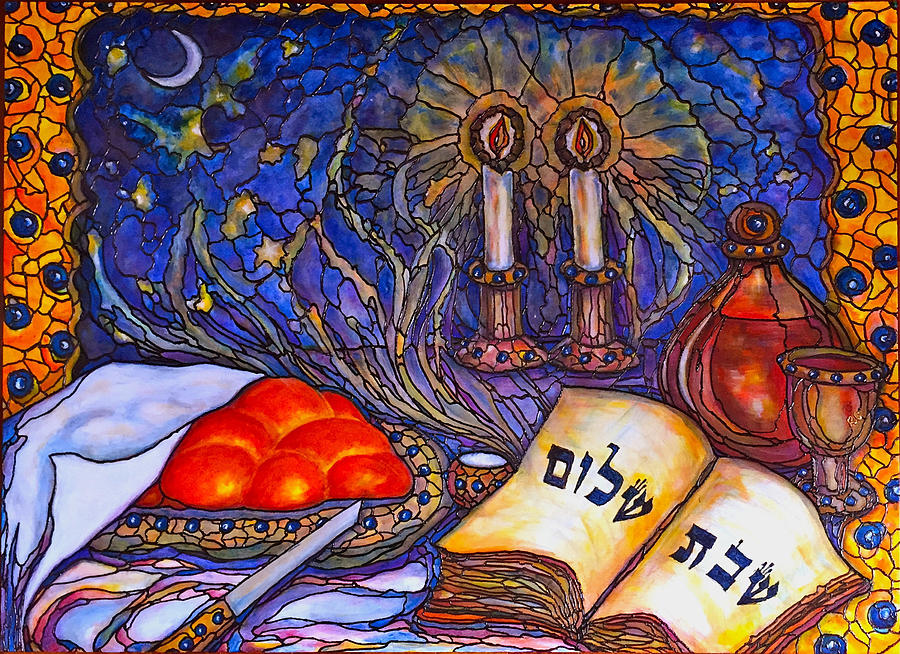
Shabbat Shalom Weekly
Torah Portion: NASO
The Blessings of a Good Heart
by Rabbi Ron Jawary
“May the Eternal bless you and protect you” (Numbers 6:24). These words were first spoken by Aharon the Kohen when he blessed the Jewish people over 3,000 years ago, and they have been used by Jewish parents to bless their children ever since.
When we ask God to bless our children, we are praying that they be granted wisdom, wealth, health, character – in essence, everything that we value. However, each of these blessings in and of themselves needs an appropriate response from us to ensure that they won’t be misused and negatively affect us.
The Remah, a 16th century sage, teaches that the way to actualize all of our blessings is to know that, “A person with a good heart will be blessed.” The heart is an organ that never stops and is always pumping life into the rest of the body. We should try to appreciate all of life’s blessings and always try to be gracious and generous with them and strive to share with others, whether spiritually, emotionally, or physically. This can ensure that our blessings will be truly good.
It is interesting that the Torah points out this week that one of the spiritual flaws that will distance a Jew from the Divine is stinginess — not just of wealth but also of spirit. An inability to give of ourselves pushes us away from God. King David says it all when he says, “Give back to God what belongs to Him, because you, and all you have, are His.”
We are only His trustees for a limited time. If we can develop such a “good heart,” we, and all those whom we come in contact with, will be truly blessed.
Making Sanctity Count
by Rabbi Dr. Benji Levy
Written texts are generally supposed to be well structured, with a clear and logical flow of thoughts, and a distinct beginning, middle and end. Yet in Parashat Naso, various topics are addressed in succession, which ostensibly lack any connection to one another.
The book of Numbers begins with the Jewish people in the wilderness prior to entering the Promised Land, and describes their housing, hierarchy and censuses. It then branches out into a variety of seemingly disparate concepts: The sin of treachery against God through theft (Num. 5:6); the sota – the wife who is suspected of acting unfaithfully (5:11-31); the nazir (Nazarite) who, in order to sanctify himself, abstains from drinking wine, cutting his hair and coming into contact with dead bodies (6:2-21); and the priestly benedictions (6:22-27).
If this were any other literary work, we might accept at face value the fact that the sections are somewhat randomly placed. However, when it comes to Torah, there is no such thing as ‘random’.
Immediately prior to these verses, the Torah describes in detail the national census – the counting of each individual in the nation. The significance of counting is even highlighted in the title of this book, ‘Numbers’.
The Hebrew word for a number is mispar, and for counting is lispor, at the root of which are the three letters S–F–R. Not coincidentally, another Hebrew word that shares the exact same root is the verb for telling, lesaper. In other words, through counting something, one is telling its story and ascribing a level of significance to it, according it its own unique identity.
The census highlights the importance of paying attention to each individual in the nation. The subsequent sections relate to different aspects of the human psyche and represent three distinct levels of the relationships that those aforementioned individuals experience: The relationship between a person and God, between a person and others, and between a person and himself or herself.
The Torah describes the consequences of stealing, and the treacherous nature of this sin. God is the ultimate source of objective morality. Any act against morality represents an act against God Himself, and as such denotes a fracture in the relationship between man and his Maker.
The Torah then draws our attention to the relationship between man and his wife. Through the discussion of the sota, the Torah hones in on the marital relationship, which by definition is founded on trust. As the family unit forms the bedrock of society, its breakdown can have catastrophic societal consequences.
The Torah proceeds to describe the nazir, a lifestyle choice that represents sanctity, the opposite of what we saw with regard to the sota. The nazir chooses to enter a lifestyle of abstinence in direct response to the previously described breakdowns in society (Tractate Sota 2a). He overcomes his desires by abstaining from physical pleasures.
On the one hand, the nazir is called ‘holy to God’ (Num. 6:8) for removing potential stumbling blocks and elevating himself. On the other hand, his choice of personal separation from the material world comes at the expense of enjoying the God-given pleasures of life. He is therefore commanded to bring a sin offering upon completion of this period of abstinence (Num. 6:13-14; Tractate Taanit 11a, Nedarim 10a). While abstinence from things that are permitted is a legitimate decision, such a personal choice must be temporary, and is inherently flawed. This dialectic (Mishneh Torah, Laws of Personal Development 3:1, Laws of Naziriteship 10:14) forms the third sphere of human relationships – that of a person’s relationship with himself or herself.
The Torah goes on to describe the priestly blessings, which actually represent the common thread running through the seemingly disparate topics mentioned above. In each case, the priest – Kohen – plays an integral role, through ritual actions and words, in preserving sanctity and redressing the balance and harmony for the nation in the different levels of their relationships.
The sacred role of the priest reminds us that we have tools and community resources available to us, and that ultimately we are all able to control our actions, to elevate our behaviour, to choose a lifestyle that builds rather than destroys, to sanctify our souls and to preserve our relationship with God, with our partners and with ourselves. If we are able to live in such a way, we will make our lives ‘count’, we will imbue them with purpose, and we will ensure that we are a worthy receptacle of the priestly blessing stated in the Torah: that Hashem should bless us, guard us, shed light upon us, be gracious to us and grant us peace.
Enjoy Life
by Nesanel Yoel Safran
From This Week’s Torah Portion
Life’s meant to be enjoyed. This week’s Torah portion disapproves of someone purposely depriving himself of enjoyment (Num. 6:11,Rashi). The Torah way is to enjoy and appreciate God’s beautiful world.
In our story, a girl discovers how to have some ‘serious’ fun.
“What do you mean, ‘you’ll pass’?” Sandy asked her friend, Laura, in astonishment. They were sitting on the bus, with Sandy holding a beach ball and Laura balancing a school textbook on her lap.
“What part don’t you understand?” Laura answered, annoyed. “You asked me if I was coming out to join you and the rest of the class on the lake and I said ‘I’ll pass.’ I prefer to stay in the bus and prepare for next week’s class assignment.”
“But this is a beeeeeeeach!” Sandy squealed. “The bus is stopping for a whole hour before going to the ecological museum, just so we can have some fun!”
“That’s because you probably pestered the bus driver so much that he had no choice. As for me, this is a school educational trip and I plan to use it — all of it — for educational purposes.”
Sandy rolled her eyes, looking at her friend as if she was from Alpha Centauri, then, not wanting to waste any more precious beach time, she bounded off the bus.
Laura didn’t care. Just because her classmates needed to waste their time with silly distractions it didn’t mean that she had to do so. She pulled the notebook closer to her face, trying not to let the laughing and noise outside distract her from her serious studies.
Some time passed and Laura heard the sound of someone stepping up onto the bus. She looked at her watch. Had an hour passed already? No… From the corner of her eye, she could see that it was Ms. Evans, their ecology-studies teacher.
At least she must appreciate that I’m the only one using my time wisely, Laura told herself with pride as she tried to look even more studious and serious than she already did.
She felt a light touch on the shoulder and looked up.
“Laura, is everything okay?” her teacher asked.
“Sure, perfect. Just trying to get ahead on the next assignment,” Laura smiled, expecting the teacher to smile back in approval. But instead, she appeared concerned.
“I understand…,” she said “but now everyone’s taking some time to enjoy the lakeside. Don’t you think…”
“Oh, don’t worry,” Laura cut in. “I don’t mind if they need that kind of recreational stuff. Me, I can take things seriously.” By now, Laura was sure she’d get approving smile. The teacher frowned.
“I know you’re a serious student,” she said, “and that’s great. But there’s also time to step back and relax. That’s one of the reasons we take class trips from time to time.”
Laura was getting upset. “But isn’t this supposed to be an ‘educational’ trip? Isn’t it better for me to use the whole trip for serious, educational purposes?”
Now the teacher did smile.
“Well I can’t argue with you there.” Laura was glad she’d won her point. But then the teacher went on, “So put down your book and come on out.”
“What?”
“This is an ecology class, remember?”
“So?”
“So there’s no better way to study the ecology than to come out and experience it! Enjoy its beauty. Experience first hand how good it can make you feel and why it’s worth protecting. Come on!”
Laura could tell the teacher wasn’t taking ‘no’ for an answer, so, reluctantly she stepped out of the bus.
Right away, the wind hit her hair. Laura drew a deep breath. The lake breeze smelled so … refreshing.
“Hey, you’re just the one more we need for the volleyball game!” Sandy cried out, seeing her. Laura looked at the teacher.
“Go enjoy yourself,” she smiled.
The next 45 minutes passed like five. As the thoroughly refreshed, happy and relaxed kids climbed back up on the bus, Laura knew she’d just gotten an important lesson about ecology — and about life.
Discussion Questions
Discussion Questions
Ages 3-5
- How did Laura first feel about going out to join the others?
A. She didn’t want to do it or feel like it was important. - How did she feel in the end?
A. She was happy she went out and let herself enjoy life.
Ages 6-9
- What life-lesson do you think Laura learned that day?
A. She’d felt that the ‘right’ way to be was always be serious and do ‘serious’ things. But she discovered that an important and worthwhile part of life was to devote time to relaxing and enjoying life, too. - Do you think taking time to relax would lead a person to accomplish more, or less?
A. A person’s not a machine. If he is just super-intense all the time, he’s bound to burn out. By taking time once in a while just to relax and enjoy life, we’ll have much more energy to accomplish our goals.
Ages 10 and Up
- Do you think God wants us to be happy and enjoy life? Why or why not?
A. There is no one who wants us to be as happy as God does. He’s the ultimate giver and gave us life as the ultimate gift. Don’t you think a giver wants his gift to be enjoyed? - If so, why are there so many sad things in life?
A. This is a deep question and there are no easy answers. But there are answers and one of them is that the ultimate pleasure that exists and that God wants to give us spiritual pleasure and sometimes that can only be acquired through struggle and looking beyond the apparent.
Quote of the Week
“Your fellow is your mirror. If your own face is clean, so will be the image you perceive. But should you look upon your fellow and see a blemish, it is your own imperfection that you are encountering.” — Rabbi Israel Baal Shem Tov, quoted in Me’or Einayim, Parshat Chukat
Joke of the Week
Five-year-old son Moishe was learning how to make brachot, blessings, before he ate. He was having some trouble so his mother told him that if he can’t remember what to say, he can just say, “Thank you, Hashem, for this delicious food.”
One evening, however, Moishie’s mother noticed that he thanked Hashem for the birds, the trees, each of his friends, and asked God to watch over his family and help. Moishie’s mother thought it was so cute and heartfelt.
But after Moishie took a spoonful of soup, he gasped, then dropped his spoon into the bowl. “I should have said a longer prayer,” he said. “My food is still too hot.”
Shabbat Shalom!
Staff: Rabbi Yosef David, Rabbi Shmuel Greenwald, Mimi David, Shelley Dean, Caren Goldstein, Orit Kogan
Board of Directors: Jenn Cohen, Adam Herman, Brett Fox, Bob Kaiser, Lizzy Goldenhersh Kline, Mike Minoff, Ella Pernik, Leila Redlich, Caryn Rudman, Bruce Waxman, Tziona Zeffren
